Introduction: Why This Question Even Exists
For years, SEO was simple to explain:
“Optimize your website so Google ranks you higher.”
But today, people are no longer just searching — they are asking questions to AI.
They ask:
- ChatGPT
- Google SGE
- Bing Copilot
- Perplexity
- Voice assistants
And suddenly, a new term started appearing: GEO – Generative Engine Optimization.
So naturally, businesses ask:
- Is SEO still relevant?
- What is GEO exactly?
- Do I need GEO instead of SEO?
- Can both work together?
- Why does my website rank on Google but not appear in AI answers?
Let’s answer everything, step by step.
What Is SEO? (Search Engine Optimization)
Simple Definition
SEO is the practice of optimizing your website so it ranks higher on traditional search engines like Google and Bing.
When someone types:
“Best digital marketing consultant in Chandigarh”
SEO decides:
- Which websites appear
- In what order
- On which page
How SEO Works (In Simple Words)
SEO works mainly on:
- Keywords – What people type
- Content – How well you answer that query
- Technical health – Speed, mobile, structure
- Authority – Backlinks, trust signals
- User behavior – Clicks, time on page
Simple SEO Example
If someone searches:
“How to open a demat account”
SEO tries to show:
- Blog articles
- Broker websites
- Step-by-step guides
The goal:
➡ Rank your page in Top 10 blue links
Key Strength of SEO
✔ Brings consistent traffic
✔ Great for transactional & local searches
✔ Still drives majority of website leads
✔ Works well for websites, blogs, service pages
What Is GEO? (Generative Engine Optimization)

Simple Definition
GEO is the practice of optimizing your content so AI systems choose your brand, website, or content while generating answers.
GEO does not focus on ranking links.
It focuses on:
Being cited, referenced, or summarized by AI.
How GEO Works (In Simple Words)
When someone asks:
“Explain GEO vs SEO”
AI does NOT show 10 links first.
It:
- Reads many sources
- Understands context
- Generates one combined answer
GEO helps AI decide:
- Which sources are reliable
- Which explanations are clear
- Which brand deserves to be mentioned
Simple GEO Example
User asks ChatGPT:
“Which is better, SEO or GEO for small businesses?”
ChatGPT:
- Doesn’t “rank” pages
- It summarizes knowledge
- It prefers clear, structured, expert-style explanations
If your content:
✔ Answers clearly
✔ Uses natural language
✔ Covers related questions
→ AI is more likely to use your ideas.
The Core Difference Between GEO and SEO
| Aspect | SEO | GEO |
|---|---|---|
| Focus | Ranking pages | Being referenced in AI answers |
| Output | Blue links | Generated responses |
| Keywords | Very important | Context matters more |
| Structure | Optimized pages | Logical explanations |
| Traffic | Click-based | Visibility & authority |
| User action | Click & visit | Read answer directly |
Is GEO Replacing SEO?
Short Answer: NO
Correct Answer: GEO is evolving SEO
SEO is not dying.
Search behavior is changing.
People now:
- Search on Google
- Ask AI for explanations
- Use voice search
- Trust summarized answers
SEO gets you found
GEO gets you understood
Why SEO Alone Is No Longer Enough
Let’s be honest.
Earlier:
Ranking #1 = traffic
Now:
- Google shows AI overviews
- Zero-click searches are increasing
- Users get answers without clicking
So businesses ask:
“My site ranks, but traffic is not growing — why?”
Answer:
➡ Because SEO visibility ≠ AI visibility
Why GEO Alone Is Also Not Enough
GEO depends on:
- Existing content
- Authority
- Credibility
Without SEO:
❌ No structured website
❌ No indexed pages
❌ No trust foundation
GEO needs SEO as its base layer.
SEO vs GEO Based on Search Intent
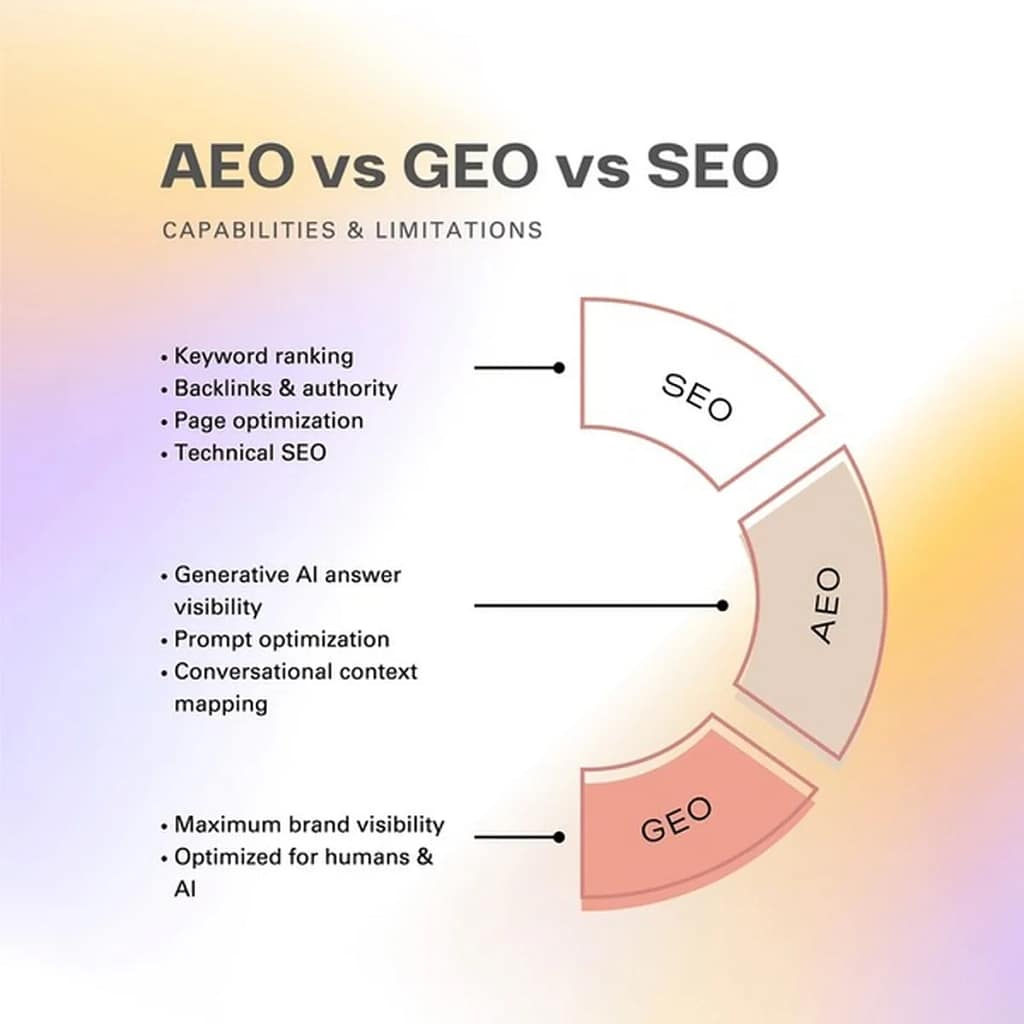
Informational Intent
Example:
“What is GEO vs SEO?”
✔ GEO plays a bigger role
✔ AI answers dominate
Commercial Intent
Example:
“SEO services in Chandigarh”
✔ SEO dominates
✔ People want websites, pricing, contact
Transactional Intent
Example:
“Hire digital marketing consultant”
✔ SEO + Ads
✔ GEO supports authority but doesn’t convert directly
Common Questions People Ask (Answered Clearly)
Is SEO dead?
No. SEO is evolving, not dying.
Do I need GEO if I already do SEO?
Yes, if:
- You want long-term authority
- You want AI visibility
- You want to future-proof content
Can a small business benefit from GEO?
Yes.
Especially:
- Consultants
- Advisors
- Service professionals
- Educators
Is GEO only for big brands?
No.
In fact, clear niche experts benefit more.
Does GEO need keywords?
It uses concepts, not exact-match keywords.
How does AI decide which content to use?
AI prefers content that:
- Is well-structured
- Explains “why” and “how”
- Answers follow-up questions
- Sounds human and expert
How SEO and GEO Work Together (Best Strategy)
Step 1: Strong SEO Foundation
- Proper site structure
- Optimized pages
- Fast loading
- Mobile-friendly
Step 2: GEO-Friendly Content Style
- Question-based headings
- Natural language
- Examples
- Sub-answers within content
Step 3: Topical Authority
Instead of 1 article:
- Create content clusters
- Cover a topic deeply
This helps:
✔ SEO rankings
✔ GEO credibility
Example: SEO + GEO in Action
Topic: Digital Marketing Consultant
SEO Page:
- Service page
- Location-based
- CTA-focused
GEO Content:
- “How to choose a digital marketing consultant”
- “SEO vs GEO explained”
- “Is AI changing digital marketing?”
Result:
- Google traffic
- AI mentions
- Brand authority
The Future: What Businesses Should Actually Do
Instead of asking:
SEO or GEO?
Ask:
“How do we stay visible everywhere people search or ask questions?”
Correct approach:
✔ SEO for traffic
✔ GEO for trust
✔ Content for humans
Final Verdict: GEO vs SEO
SEO brings users to your website.
GEO brings your expertise into AI conversations.
The winners will not choose one.
They will combine both intelligently.
One-Line Summary (For Busy Readers)
SEO helps you rank. GEO helps AI understand and trust you. Smart businesses use both.